it is with great sadness that we heard of the passing of John Larkin on Wednesday. John was a long time member of the society, a committee member and gave some presentations at Christmas functions. You might remember too his daughter, Hilary speaking to the society.
Go gcumhdaí Dia agus na haingle é.
Information ragarding the funeral arrangements on Tuesday and house visitation are on RIP. Maybe some of you will be able to attend.
Aoife
Ar dheis Dé go raibh a anam dilís.
Reposing at his son’s residence on Monday evening, 22nd September from 5pm – 7pm. Removal on Tuesday morning to St. Colmcille’s Church, Knocklyon arriving for 11am Requiem Mass followed by burial thereafter in Kilmashogue Cemetery.
Peadar Curren grew up in Dalkey and he has had a lifelong interest in the history of the locality. He has lectured extensively on the subject to several local history societies of which he is a member. He observed the archaeological excavations on Dalkey Island in the 1950s and he was a graduate of the Lord Mayor’s Local History course in 2016.
He frequently gives talks and leads discussions on the history and heritage of Marlay Park and its surrounding areas. He has delivered presentations on various aspects of Marlay Park, including its often overlooked features and historical development from a medieval grange to a Regency-era walled demesne, and later its transformation into a public park.
Curran has also explored the connections of notable figures to Marlay House, such as the stained-glass artist Evie Hone, who lived in the Dower House on the estate and established her studio in Marlay House. His presentations often focus on built heritage elements such as entrance gates, bridges with unique keystone motifs, and the history of the La Touche family’s mausoleum.
Awards: honorary doctorate, Trinity College Dublin (1953); honorary member of Royal Hibernian Academy (1955).
Principal works: Armorial windows and Pentecost (Blackrock College Chapel, 1937–41); My Four Green Fields (1939); Saint Brigid (Loughrea Cathedal, 1942); windows for St. Stanislaus College, Tullabeg, County Offaly (1942); windows for Church of the Immaculate Conception, Kingscourt, County Cavan (1947–48); Eton College Chapel, Berkshire, England (1949–52); St. Michael’s Church, Highgate, London (1954).
Background: Evie Hone was descended from a remarkable family of Flemish artists who settled in Britain and Ireland in the 16th and 17th centuries. One of them, Galyon Hone, completed the windows for King’s College in Cambridge. Another of her ancestors was the painter Nathaniel Hone (1718–1784). Nathaniel’s two sons, Horace and John Camillus, were also painters.
In 1937, Hone was received into the Catholic Church at Blackrock College Chapel in Dublin by its president Dr. John Charles McQuaid, who had commissioned windows for the college chapel from Michael Healy. McQuaid subsequently commissioned work from Hone and, when he became archbishop of Dublin in 1940, was an enthusiastic champion of her work.
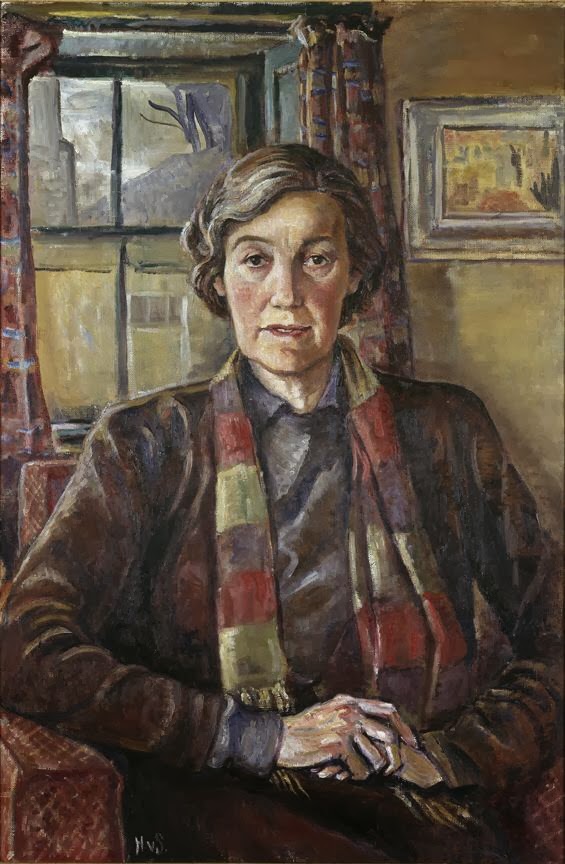
Evie Hone, became a renowned Irish stained-glass artist, who lived and worked in Marlay Park, specifically in the Dower House located within the park’s courtyard, where she established her studio in Marlay House. She is best known for her work in stained glass, a medium she began exploring in 1933 after initially establishing a reputation as a painter in oils and gouaches. Hone joined An Túr Gloine, a prominent Dublin stained-glass cooperative, and remained there until its dissolution in 1944 following the death of Sarah Purser. After this, she set up her own studio at Marlay Grange, Rathfarnham, where she produced some of her finest works.
Her most celebrated piece is the large east window at Eton College Chapel, Windsor, completed in 1952, which covers 900 square feet and comprises over 40,000 pieces of glass, bringing her international fame. Other significant works include the ‘My Four Green Fields’ window, commissioned by the Irish government for the New York World Fair in 1939, which won first prize in its category. She also created windows for various churches across Ireland, including the Jesuit colleges at Tullabeg, Clongowes Wood, and Rockwell College, as well as the Church of St. Peter and Paul in Athenry.
Hone’s connection to Marlay Park is deeply celebrated, and events are held there to honor her legacy. A talk titled “Evie Hone, Stained Glass Artist of Marlay” was scheduled for 3 June 2025 at Marlay Park House, and another event on 30 April 2025 marked the 70th anniversary of her passing, taking place in the room next to her former studio. She died on 13 March 1955 while on her way to mass in Rathfarnham. Her artistic legacy, bridging modernist painting and stained glass, continues to be recognized, with her works featured in collections across Ireland, the UK and America.
Brendan was principle in Coláiste Éanna and Chairperson of the Board of Loretto High School, Beaufort. He was also heavily involved in a broad range of educational initiatives especially since his retirement including mentoring of newly appointed principles, emphasising excellence in teaching and learning, strategic short and medium term planning. Acting as an examiner for DCU in the role of placement tutor observing and evaluating student teachers in second level schools. Acting as an examiner for the Marino Institute of Education in the role of placement tutor observing and evaluating student teachers in the further education sector. Sitting on the Board of Directors of the Edmund Rice Schools Trust and chairing the Ethos Subcommittee. Sitting on the Safeguarding Committee of the Carmelite Order in Ireland. For more information please link here: Linkedin.com
Brendan is also writer and presenter of The Belly of Beast Podcast (GoLoud) On the 100th anniversary of the death of Michael Collins, this podcast tells the fascinating story of Ned Broy, the double agent who helped Collins change the course of Irish history. The story begins when a Dublin based history teacher named Brendan McCauley learns that he has bought Ned Broy’s original home. This starts a voyage of discovery concerning Broy and his critical involvement in Irish history.
Ned Broy. Image: Wikipedia.org
Eamon “Ned” Broy, born in 1887 and died in 1972, was a significant figure during the Irish War of Independence, acting as a double agent within the Dublin Metropolitan Police (DMP) and providing crucial intelligence to Michael Collins. He joined the DMP in 1911 and worked as a clerk in G Division, the intelligence branch of the DMP, where he copied sensitive files for IRA leader Michael Collins.
On April 7, 1919, Broy smuggled Collins into G Division’s archives in Great Brunswick Street (now Pearse Street), enabling Collins to identify “G-Men,” six of whom would later be killed by the IRA. This operation was less dramatic than depicted in the film “Michael Collins,” where Broy is inaccurately portrayed as having been arrested, tortured, and killed by SIS agents.
Ned Broy 1933. Image: rte.ie
Broy supported the Anglo-Irish Treaty of 1921 and joined the National Army during the Irish Civil War, reaching the rank of colonel. He later became the Garda Commissioner in 1933, a position he held for five years, and established the Auxiliary Special Branch within the Gardaí, nicknamed the “Broy Harriers”.
Clcik to enlarge images.
In recognition of his contributions, a monument was unveiled in his honor in 2016 at his graveside in Coolygagen cemetery, County Offaly.
Left image: Ned Bory’s grave. Middle image; Aine Broy, Ned’s daughter, at unveiling of the monument to her father Eamonn ‘Ned’ Broy in 2016. Right image: The Tri-Colour lowered and marched from Cooleygagen following the Broy memorial event in 2016.
Main bullet points:
Eamon “Ned” Broy: Born in 1887, died in 1972, served as a double agent within the DMP, provided intelligence to Michael Collins, and later became Garda Commissioner.257
Michael Collins: Irish revolutionary leader who received vital intelligence from Broy during the Irish War of Independence.257
Dublin Metropolitan Police (DMP): Police force in Dublin where Broy worked as a clerk in G Division, the intelligence branch, and copied sensitive files for Collins.257
G Division: Intelligence branch of the DMP where Broy worked and provided information to Collins.257
National Army: Military force Broy joined during the Irish Civil War, reaching the rank of colonel.27
Garda Síochána: Irish national police force where Broy served as Commissioner from 1933 to 1938 and established the Auxiliary Special Branch.27
Auxiliary Special Branch: Formed by Broy in 1934 within the Gardaí, nicknamed the “Broy Harriers”.27
Coolygagen Cemetery: Location of Broy’s graveside where a monument was unveiled in his honor in 2016.35
Michael Russell’s “The City of Shadows”: A detective novel where Broy makes an appearance, set partly in Dublin in the 1930s.
Title: Queen Victoria’s Visit to Killarney – August 1861 Speaker: Frank Tracy Time: 7:45pm Location: Iona Pastoral Institute
Via Aoife O’Tierney KPresenter: Frank has presented talks our society previously and produced the book on the Massay Woods some years ago.
Outing: this year’s outing will be on Saturday the 7th June. We hope to visit the Cistercian Monastery, Mount Saint Joseph, Damer House and the old Castle, then visit the Black Mills, which now houses the Celtic Cross from Saint Cronán’s monastery ruins nearby. Evening meal at the Céidin Hotel. More to follow.
————— Editor: limited post due to computer broadband issues. Sent by phone. —————
Title: Cornelius Ryan Speaker: Philip Lecane, Historian. Time: @ 7:45 PM Location:Iona Pastoral Centre
Presenter: Philip Lecane, Historian. This evening Philip takes us on a whirlwind tour of the life and times of Cornelius Ryan, but as Aoife O’Tierney recounts many members may recall Philip giving a ‘great talk’ on the sinking of the RMS Leinster in a previous talk.
Philip Lecane Historian
Philip moved to to Dun Laoghaire, County Dublin (known as Kingstown at the time of the RMS Leinster sinking) in 1984. He first became aware of the sinking when a number of references were made to it at local history society meetings. Surprised that so little was known about the event, he was drawn to research the story. In 2005, his book Torpedoed! The RMS Leinster Disaster was published. In 2003 and 2008 he chaired committees which planned very successful RMS Leinster commemorative events. He worked with Canadian Will Lockhart to create the website http://www.rmsleinster.com. In 2015, his book Beneath a Turkish Sky: The Royal Dublin Fusiliers and the Assault on Gallipoli was published. In 2018, on the centenary of the sinking, his book Women and Children of the RMS Leinster: Restored to History was published. A committee member of the Royal Dublin Fusiliers Association and Foxrock (County Dublin) Local History Club. He has also worked on a biography of Irish First World fighter ace George McElroy.
Cornelius Ryan (5 June 1920 – 23 November 1974) was an Irish journalist and author known mainly for writing popular military history.
Cornelius Ryan
Ryan was the son of a British soldier and an Irish-nationalist mother. His grandfather had been an irascible journalist in Ireland and young Connie soon determined journalism for his own career. Still in his early 20s, he was sent by a London newspaper to cover American G.I.s in Britain. At first he found it difficult, but later admitted that, “Among those brash, irreverent, confident [American] soldiers, I found my spiritual home.” He viewed D-Day from a ship in the invasion fleet.
He became one of the preeminent war correspondents of his time, flying fourteen bombing missions with the Eighth and Ninth US Air Forces and covering the D-Day landings and the advance of General Patton’s Third Army across France and Germany. After the end of hostilities in Europe, he covered the Pacific War.
Below a British Paté news reel of the ‘Longest Day’ – the D-Day landings on June 6th 1944.
After the war, he covered the establishment of Israel. He immigrated to the United States in 1947 to work for Time. He left Time in 1949, served briefly with Newsweek, and joined the Collier’s staff as an associate editor in 1950. During that same year he also married Kathryn Morgan and became a naturalized citizen of the United states. During Ryan’s association with Collier’s, he achieved international recognition for his journalistic reporting of the United States space program and introduced Wernher von Braun to the American public. In 1956, two of his articles, “One Minute to Ditch” and “Five Desperate Hours in Cabin 56″ gained him three national awards for distinguished magazine writing: the Benjamin Franklin award, the Overseas Press Club award, and the University of Illinois award.
He was awarded the Christopher Award for the best book on foreign affairs in 1959 and the Bancarella Prize (Italy) in 1962. Pursuing journalism in the United States after the war, he finally persuaded Reader’s Digest to underwrite his effort to write a book for the 15th anniversary of the Normandy invasion. He flung himself into the work, interviewing not only Americans, Canadians and British, but also French and Germans. He joined the staff of Reader’s Digest immediately following the publication of The Longest Day, continuing his career in journalism while beginning research on his second World War II battle book, The Last Battle, which was published in 1965.
In addition to his classic works He was especially known for his histories of World War II events: The Longest Day: 6 June 1944 D-Day (1959), The Last Battle (1966), and A Bridge Too Far (1974), he is the author of numerous other books, which have appeared throughout the world in nineteen languages. Awarded the Legion of Honor by the French government in 1973, Mr. Ryan was hailed at that time by Malcolm Muggeridge as “perhaps the most brilliant reporter now alive.”
Cornelius Ryan Photo Gallery: click image to enlarge. Click on the (i) Information icon, bottom right of gallery for further information on some images.
Source: Cornelius Ryan Last Battle Promotional Film via mrb6812 on YouTube
He was diagnosed with prostate cancer in 1970 at age 54, and he began a program of chemotherapy. Meanwhile, he continued his research and writing on the third of his battle books, A Bridge Too Far. In July of 1973 he was awarded the French Legion of Honor in recognition of his contributions to the fields of journalism and historical writing. The following year A Bridge Too Far was published and he was awarded an honorary Doctor of Literature degree from Ohio University. During the publicity tour for his last book he re-entered the hospital and died of cancer on November 23, 1974.
The notes and tapes he made during his bout with cancer were compiled and edited along with his wife’s diaries and published in 1976 as A Private Battle.
Title: Arthur Griffith and Michael Collins in Contrast Speaker: by Catherine Scuffil and Liz Gillis Time: @ 7:45 PM Location:Iona Pastoral Centre
Catherine Scuffil has an MA in Local History from Maynooth University. She is currently the Historian in Residence for Dublin’s South Central area which includes the historic Liberties and some of the city’s oldest suburbs. Catherine has written a number of local history books and an abridged version of her MA thesis was awarded the Old Dublin Society’s silver medal in 2018. Source: History on Your Doorstep.
Liz Gillis is an author and historian from the Liberties. She has a Diploma in Classical Animation Studies and a Degree in Irish History. Liz currently works as a Researcher for the History Show on RTE Radio and has lectured at Champlain College since 2018. She was a Curatorial Assistant in RTE, specialising in researching the Easter Rising and a tour guide for many years in Kilmainham Gaol. Liz is the author of six books about the Irish Revolution. In 2018 Liz was a recipient of the Lord Mayor’s Award for her contribution to history. Source: Champlain College.
Michael Collins Photo Gallery: click image to enlarge. Click on the (i) Information icon for further information on some images.
Arthur Griffith Photo Gallery: click image to enlarge. Click on the (i) Information icon for further information on some images.
Arthur Joseph Griffith (Irish: Art Seosamh Ó Gríobhtha or Art Ó Gríofa; 31 March 1871 – 12 August 1922) was an Irish writer, newspaper editor and politician who founded the political party Sinn Féin. He led the Irish delegation at the negotiations that produced the 1921 Anglo-Irish Treaty, and served as the president of Dáil Éireann from January 1922 until his death later in August.
Commentary While both men were instrumental in the struggle for Irish independence, their visions for Ireland’s future differed. Griffith’s approach was more moderate and sought to find a compromise with Britain, while Collins was more radical and focused on achieving full independence. Despite their differences, they worked together during the negotiations of the Anglo-Irish Treaty and both died within ten days of each other in 1922, during the Irish Civil War.
Other references: Jock McPeake was the last person to speak with Michael Collins before he was shot during the ambush. Jock was the Vickers machine gunner in the armoured car in which Collins was travelling in and recounts those last moments when it came under fire on “its return journey from Collins’ home in Woodfield near Clonakilty. More details: independent.ie
Sliabh na mBan – The Jewel in the crown. By Bob Webster & Sister Veronica Treacy History of the famous armoured car used by Michael Collins, with further images.
Memorabilia from the 1916 Easter Rising. Photo Gallery: click image to enlarge. Click on the (i) Information icon for further information on some images.
Title: ‘Seamus Heaney Poems’. Speaker: KHS members Time: @ 7:45 PM Location:Iona Pastoral Centre
Reminder from Aoife O’Tierney Our Christmas Celebrations and the reading by members of a selection of Seamus Heaney Poems takes place Wed. Dec. 11th at 7:45pm, followed by the Christmas Raffle and Mince Pies etc.
Promises to be a GREAT NIGHT
Click on the first image to open the slideshow. Image source acknowledged within the slideshow below the image in a description.
Click on image below to run video: Duration 50 mins.
Heaney was born in the townland of Tamniaran between Castledawson and Toomebridge, Northern Ireland. His family moved to nearby Bellaghy when he was a boy. He became a lecturer at St. Joseph’s College in Belfast in the early 1960s, after attending Queen’s University and began to publish poetry. He lived in Sandymount, Dublin, from 1976 until his death.[7] He lived part-time in the United States from 1981 to 2006. He was a professor at Harvard from 1981 to 1997, and their Poet in Residence from 1988 to 2006. From 1989 to 1994, he was also the Professor of Poetry at Oxford. In 1996 he was made a Commandeur of the Ordre des Arts et des Lettres and in 1998 was bestowed the title Saoi of Aosdána. He received numerous prestigious awards.
Heaney is buried at St. Mary’s Church, Bellaghy, Northern Ireland. The headstone bears the epitaph “Walk on air against your better judgement”, from his poem “The Gravel Walks”.[8]
Catherine Scuffil has an MA in Local History from Maynooth University. She is currently the Historian in Residence for Dublin’s South Central area which includes the historic Liberties and some of the city’s oldest suburbs. Catherine has written a number of local history books and an abridged version of her MA thesis was awarded the Old Dublin Society’s silver medal in 2018. Source: History on Your Doorstep.
Title: ‘The Royal College of Surgeons in Ireland’ Speaker: Dr. Ronan Kelly Time: @ 7:45 PM Location:Iona Pastoral Centre
Dr. Ronan Kelly
Dr. Ronan Kelly is the author of ‘Every Branch of the Healing Art’: A History of the Royal College of Surgeons in Ireland, which “traces the evolution and impact of the institution since its foundation in 1784 when a small group of Irish surgeons broke ranks with the Guild of Barber-Surgeons to form the Royal College of Surgeons in Ireland”.
“It explores the institution’s national and international impact as a trailblazer in surgical and health sciences education, its legacy of driving global improvements in human health and maps its journey to becoming Ireland’s first health sciences university”.
“The book also sheds new light on periods of huge social change and unrest, exploring RCSI’s journey through two World Wars, the 1916 Rising, right up to its response to the Covid-19 pandemic, the second that the institution has endured”
“Speaking of his process when compiling an almost 250-year history, Dr Ronan Kelly said, “RCSI’s story is a gift to a writer – it already pulses with dramatic life. It’s an extraordinary privilege for me to get to share this story with others now.” “
“Dr Maurice Manning, Chancellor, National University of Ireland, is the chair of the book’s editorial board. He said: “From nineteenth-century body snatchers to the 1916 Rising, through two pandemics and two world wars, with a vivid cast of characters, and reaching right to the present day, this book is a fast-moving narrative of a great Irish – and, in recent times, global – institution.” “